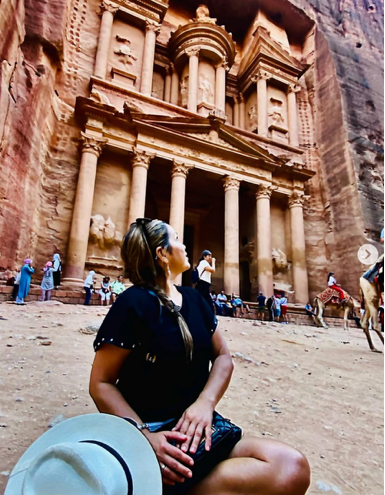

Our journey to Jordan had one clear goal: to see Petra, one of the New Seven Wonders of the World. But from the moment we arrived, the country was already shifting something inside me.
It was a deep cultural contrast, yet deeply fascinating. Seeing sheikhs walking through the city in their immaculate white robes and perfectly arranged red keffiyehs was one of the first images that stayed with me. There is something powerful and elegant in that presence. The city felt calm, organized, grounded. Different, but not distant. Simply distinct.
One thing that truly surprised me was the currency. I did not expect the Jordanian dinar to be so strong. Jordan turned out to be an expensive country, especially in tourist areas. And yet, every experience was worth it.
And then, the food.
Jordanian cuisine was a revelation. Mansaf, considered the national dish, served with rice, tender lamb, and a fermented yogurt sauce with a deep, rich flavor unlike anything I had tasted before. Maqluba, the dish that is flipped upside down before serving, revealing perfect layers of rice, vegetables, and slow-cooked meat. Hummus and mutabal, creamy and full of character, paired with freshly baked bread. Falafel, crisp on the outside and soft inside. Every meal was intense, aromatic, and rooted in tradition. Eating in Jordan is not rushed. It is about sitting together, sharing generously, and letting the spices tell their story.
And then there is Petra.
Reaching Petra is a slow revelation. You walk through narrow stone corridors, surrounded by towering canyon walls, and suddenly it appears. A city carved directly into rose-colored rock, hidden between mountains. The scale is overwhelming. The details in the stone. The way the architecture merges with the landscape so organically.
Petra is one of the New Seven Wonders of the World, and standing there, you understand why. It is not just a monument. It is a presence.
Seeing men riding horses through the ancient paths, their eyes outlined in black, makes you feel transported to another era. It is powerful. Raw. Almost cinematic. The homes carved directly into and beneath the rock are simply astonishing. Everything feels as if it was born from the stone itself.
But Jordan is not only stone.
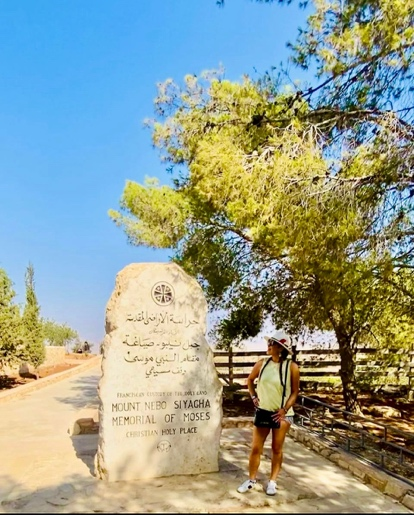
I also visited Mount Sinai, the place where, according to biblical tradition, Moses received the Ten Commandments. Being there felt different. It was not about architecture or scale. It was about story. About faith. About realizing that the narratives you heard as a child are connected to real landscapes.
During a guided tour, I learned something that deeply fascinated me: in Islam, Jesus is not recognized as the Messiah in the same way as in Christianity, but he is honored as a prophet. Seeing how the same stories weave through different religions was powerful. Everything felt more layered, more human, more connected.
And then there is the Dead Sea.
Floating in the Dead Sea is almost surreal. Your body rises effortlessly. The water feels dense, heavy, different. It is an unusual and fascinating sensation. From the shore, you can look across and see Israel on the other side. That visible border adds another layer of meaning. You are floating in one of the lowest points on Earth, between countries, between histories, between ancient narratives and modern realities.
In that moment, history stopped being abstract. It became territory.
Jordan surprised me deeply. It challenged what I thought I understood. It is a destination where desert, history, faith, and geopolitics coexist in a way that feels powerful and grounded.
Jordan leaves a mark. And while Petra is carved in stone, it is the spiritual depth of the land that truly stays with you.