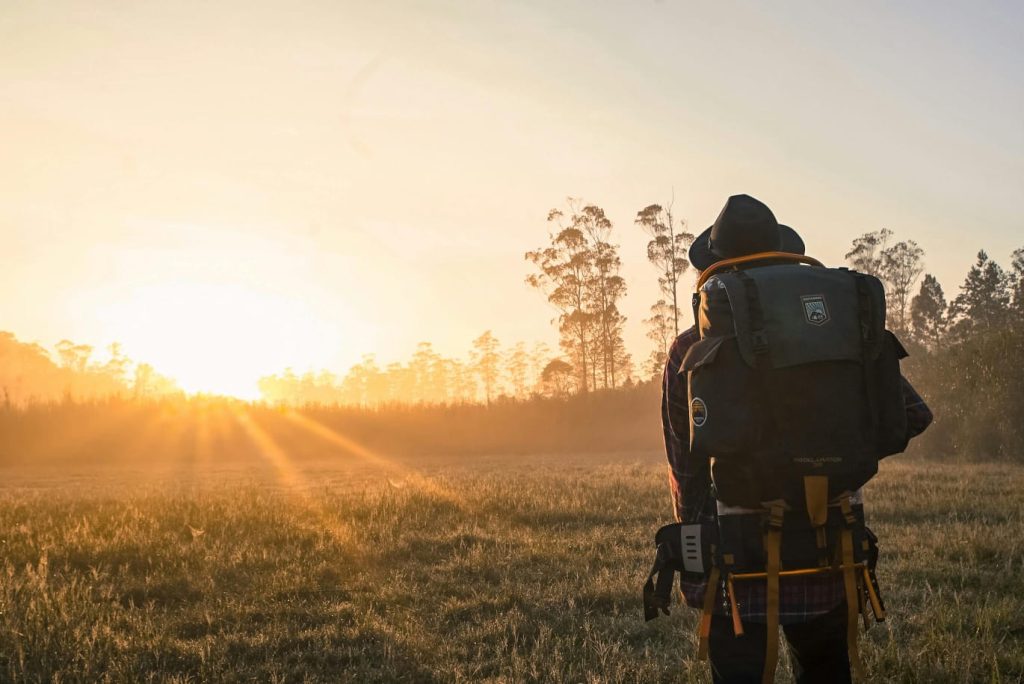

My trip to Tbilisi was born from the desire to keep expanding my personal map. Whenever I can, I choose destinations that are not on the typical route. I like opening new horizons, exploring countries that are not on everyone’s immediate list. That is how I arrived in Tbilisi, guided by pure curiosity.
One of my first days, I joined a tour called Hidden Gems of Tbilisi, and it was revealing. It showed me a city that is not immediately understood at first glance. The architecture feels almost psychedelic: buildings with cracks running through their facades as if they were about to split apart, endless spiral staircases, hidden inner courtyards, a mix of Soviet heritage and contemporary constructions, and suddenly an Orthodox church emerging in the middle of all that contrast. It is an unusual combination, yet deeply authentic.
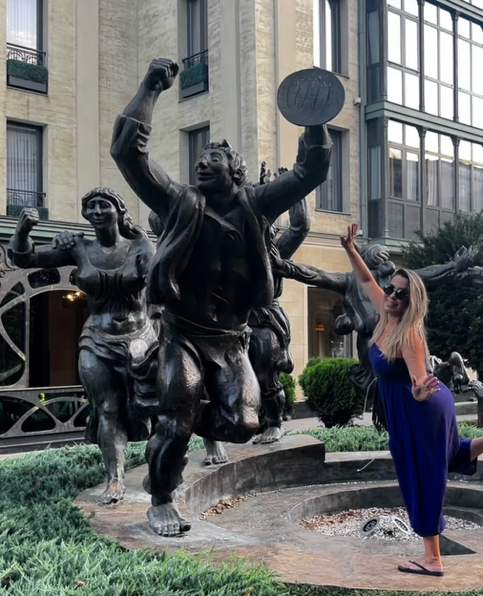
Walking through the city center is a constant visual spectacle. The Gabriadze Clock Tower looks like something out of a fairytale. Tiny doors next to larger ones, decorative figures everywhere, details that force you to pause and look twice. It is crooked, imperfect, almost improbable, and that is exactly what makes it magnetic. Every hour becomes a small urban ritual that gathers whoever happens to be passing by.
Then there is the street art. It appears on walls, in tunnels, on forgotten facades. It is not decorative, it is memory and expression. It seems to demand, to remind, to provoke. Among all the names, the one that captured my attention most was Niko Pirosmani. Although he belongs to another era, his presence still lives in the city. His love story with a French woman became legend, and visiting the house associated with his memory gives a different dimension to his art.
As part of the tour, we arrived at a local restaurant and, almost as if everything had been choreographed, steaming khinkali were served alongside Georgian wine. The guide first showed us the technique, hold them from the top, drink the hot broth, and only then take the bite, and then explained that Georgia is one of the oldest wine producing regions in the world. At that table, I understood that here gastronomy and wine are inseparable; they belong to the same living tradition, shared and celebrated together. I loved it.
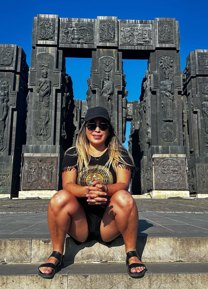
The next day I visited the Chronicle of Georgia monument. Massive columns that seem endless, rising toward the sky with carved scenes narrating history, religion, and identity. The wind blows strongly up there and the horizon opens completely. It is a place that imposes silence and reflection, an essential stop in Tbilisi. We also walked through the gardens, a peaceful space with wide views where we watched the sunset fall over the city.
Even though I only stayed in the capital, the Caucasus mountains were always present in the distance, reminding me that Georgia is far more than its main city. That is exactly why I need to return. I want to explore those mountains and continue understanding this powerful cultural blend.
Tbilisi was not just a destination. It was a revelation within my personal map of travels.