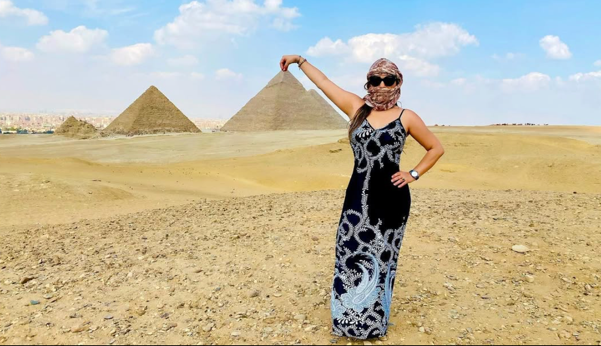

Traveling to Egypt had one very clear goal: to see the only remaining Wonder of the Ancient World still standing, the Pyramids of Giza. Just knowing you are standing in front of something that has existed for more than four thousand years shifts your perception of time.
Being beside the pyramids is not just about seeing massive stone structures. It is about feeling the weight of history. And also the weight of every theory surrounding them. How were they built? What knowledge did they possess? What do we still not understand? Egypt does not give you easy answers. It leaves you with more questions. There is so much mysticism that instead of clarifying, it deepens the mystery. And that is precisely what makes it so powerful.
The pyramids are overwhelming. But then comes Luxor.
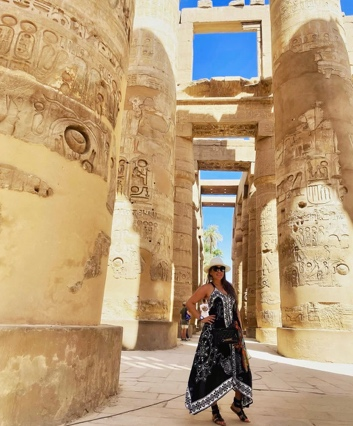
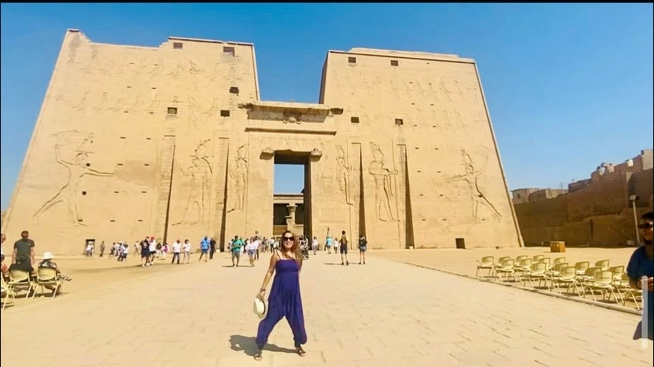
The temples of Luxor and Karnak are monumental. Massive columns, hieroglyphs carved with astonishing precision, structures that seem impossible for their time. In Karnak, the vast complex dedicated to Amun-Ra, the solar deity, reveals how deeply the worship of the sun shaped the spiritual rhythm of the civilization. Everything feels grand. Designed for eternity. The orientation of the temples, the way sunlight enters certain spaces at specific times of the year, shows that nothing was accidental. Walking among these temples makes you feel small before a culture that understood time, the cosmos, and power in a completely different way.
And then there are the tombs.
Entering the Valley of the Kings and visiting the tomb of Tutankhamun was incredibly special. You stand there, inside, looking at colors that have survived centuries, detailed carvings, symbols meant to guide a soul into eternity. For a moment, you feel like you stepped into the adventure films you watched as a child. It is magical. Unreal. Living history.
But Egypt is not only Cairo and Luxor.
I also visited Alexandria, along the Mediterranean coast. It is there, on that very spot, that the Lighthouse of Alexandria once stood, another of the Seven Wonders of the Ancient World. The lighthouse no longer exists, destroyed by earthquakes centuries ago. Today, the Citadel of Qaitbay rises in its place, built using stones from the original lighthouse. Standing there means standing exactly where one of the greatest ancient structures once illuminated the sea. It is a quiet but powerful realization. The past feels close.
And then there is the Nile.
Sailing along the Nile is a story of its own. Listening to tales of pharaohs, ancient rituals, even stories of crocodiles that once ruled its waters. The river is not just water. It is the backbone of an entire civilization. Everything in Egypt was born around it. Traveling along the Nile is understanding how desert and water shaped history.
And the food… spices, rice, flatbreads, falafel, koshari, slow-cooked stews rich in flavor. Egyptian cuisine is simple but deeply aromatic. I love food with spices, and here every dish carries warmth and depth. It feels ancestral.
Egypt is magic. It is mysticism. It is overwhelming in the best possible way.
It is not a destination you simply visit. It confronts you with time, mortality, eternity. You leave with more questions than answers, but with the certainty that you stood before something truly immense.
Egypt is not just history.
It is mystery carved into stone.